
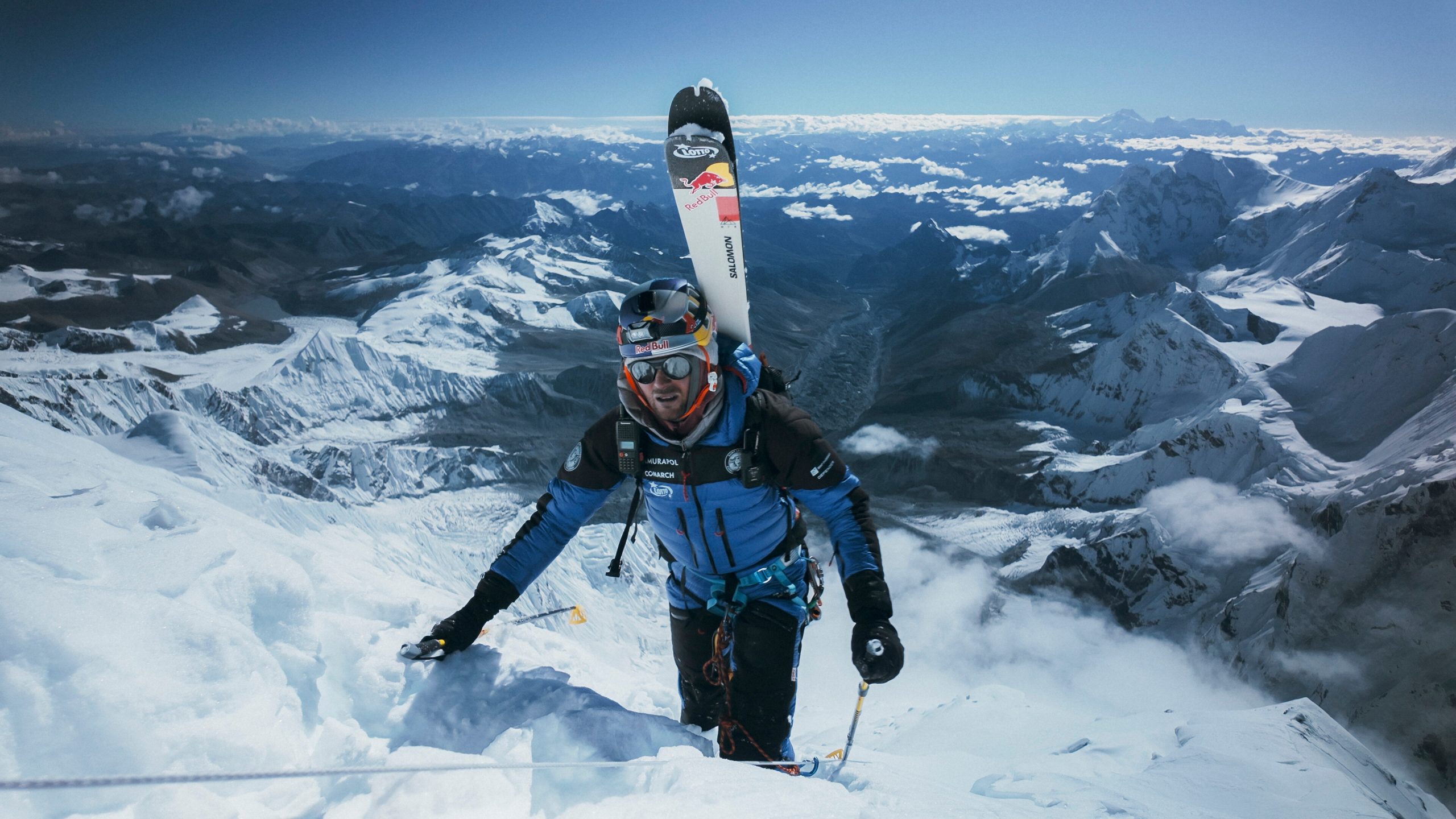
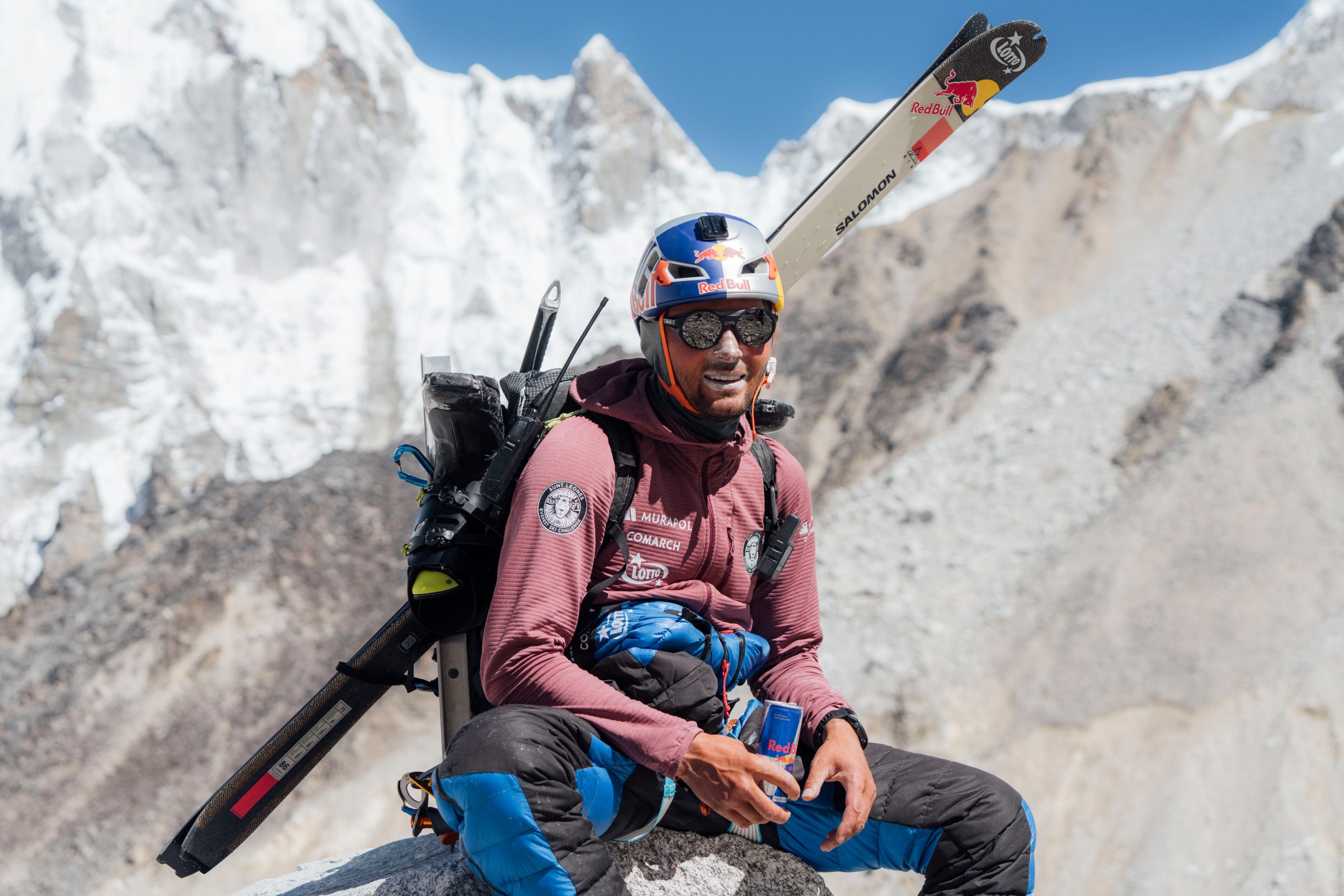
High on the South Col, the wind doesn’t stop. On 22 September 2025, Polish ski-mountaineer Andrzej Bargiel stood at 8,848 meters and committed to a line that would redefine what’s possible on Everest. He’d climbed without supplemental oxygen. Now he would ski down the same way—summit to Base Camp, in one continuous push.
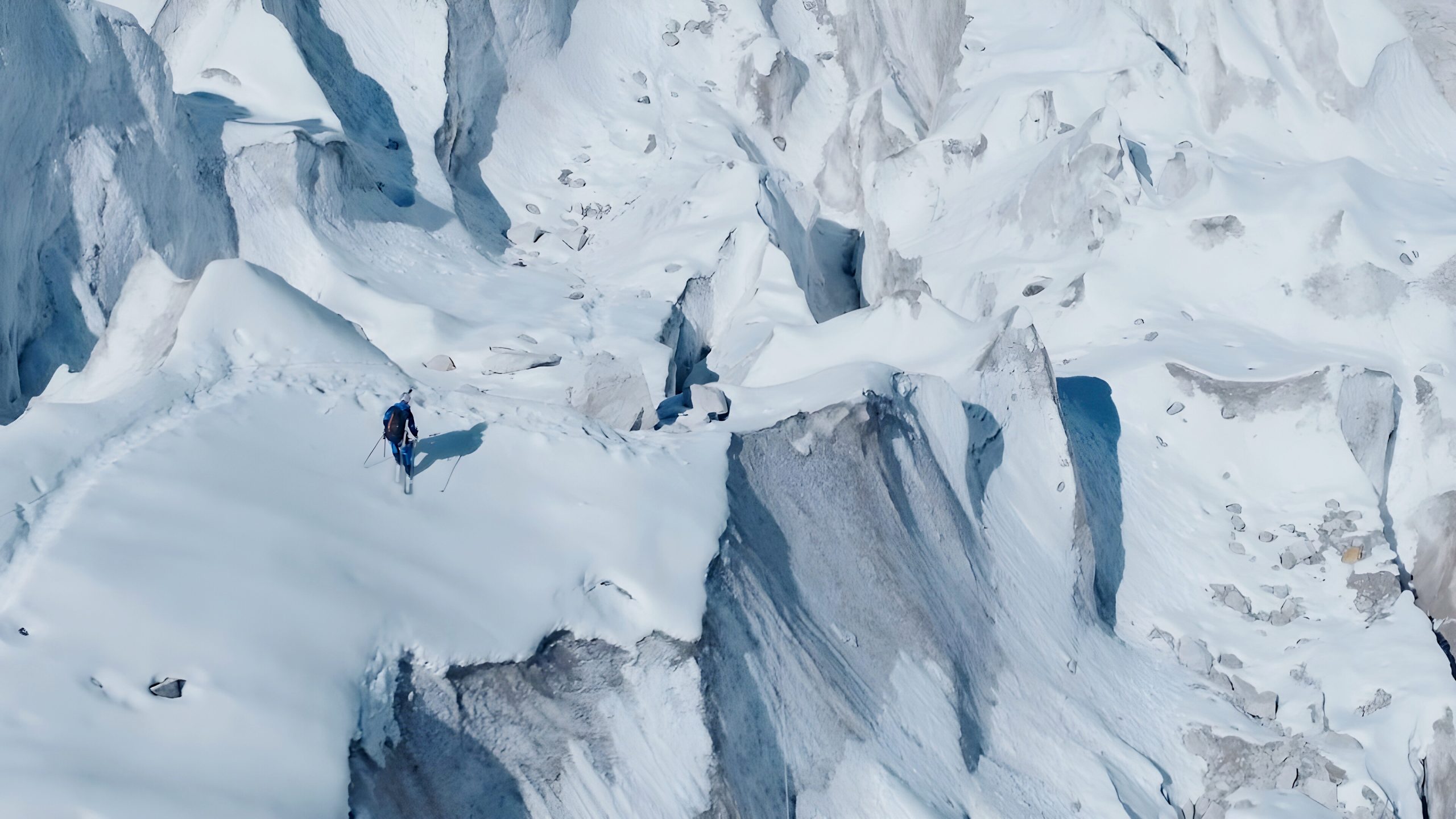
Bargiel started down the familiar South Col route, moving with the precision that’s become his trademark. He skied through the Hillary Step and past the Balcony, cut controlled turns across the Lhotse Face, and threaded through the Khumbu Icefall with the kind of micro-adjustments that separate survival from disaster at extreme altitude. A whiteout and sheer exhaustion forced an overnight stop at Camp II, breaking the descent into two stages. But by the morning of 23 September, he’d completed what no one had before: a summit-to-Base Camp ski descent without bottled oxygen.
The footage released by his team through Red Bull Content Pool shows narrow, controlled turns through wind-packed snow. The achievement goes beyond athletics—Bargiel spent nearly 16 hours above 8,000 meters, in air holding only a third the oxygen of sea level. It was deliberate, surgical skiing at the edge of human physiology.
Three weeks later, Jim Morrison approached Everest from the north. On 15 October 2025, the American skier summited and dropped into the Hornbein and Japanese Couloirs—a line through Everest’s North Face that had defeated or killed previous attempts. Morrison skied 2,760 meters (9,055 vertical feet) in a single push, completing the descent in 4 hours and 5 minutes. The route demanded everything: extreme pitch, narrow chutes, and sections where he had to remove his skis to downclimb or rappel.
Where Bargiel’s descent was a study in control and patience, Morrison’s was speed and improvisation. His expedition was documented by a small media team led by Jimmy Chin and Chai Vasarhelyi. Morrison dedicated the descent to Hilaree Nelson, his late partner who died on Manaslu in 2022. For him, this wasn’t just a technical goal—it was personal.
Both descents made history, but in different ways. Bargiel completed the first no-oxygen summit-to-Base ski descent on Everest. Morrison became the first to ski the full Hornbein Couloir route—a line that has claimed lives, including Marco Siffredi who disappeared there in 2002. Both men had film crews documenting their attempts, footage that will define this era of extreme skiing.
What connects these stories isn’t just vertical meters or permits. It’s the insistence that the mountain be engaged on the athlete’s terms. Bargiel’s career reads like a ledger of calculated risks: meticulous acclimatization, drone reconnaissance of lines, and conservative decision-making that adds up to extraordinary achievements. His Everest descent was the culmination of years of planning—merging purity of ascent and descent on the world’s highest peak.
Morrison carries different influences. He’s shaped by freeride culture and a lifetime of steep skiing. His ascent and descent were both deeply personal and public, filmed for documentary release. In interviews, Morrison described the line as an offering—a way to honor shared obsession and lost partnership.
There’s no clean way to compare these descents. Was Bargiel’s no-oxygen approach more impressive? Or Morrison’s first descent of the Hornbein? The debate misses the point. Each descent changed what we thought possible. Bargiel reframed physiological limits at altitude. Morrison proved a legendary line could actually be skied. They pushed the sport forward from different angles—one through sustainable technical execution, the other through aesthetic audacity.
At Base Camp, Sherpa teams who supported both expeditions measured the conditions with practical language: window, cornice, serac. For them, the difference between success and tragedy is measured in weather windows and timing. The footage from both descents—high-resolution imagery from Red Bull Content Pool for Bargiel and Morrison’s personal media team—will be studied for decades.
If there’s a lesson here, it’s not about hubris or humility. It’s about how skill and judgment play out on steep snow. Bargiel and Morrison practice different approaches to the same mountain. One is methodical and precise. The other is intuitive and fast. Together they show that modern ski mountaineering isn’t one thing—it’s a conversation between technique and temperament, between what we can measure and what it costs.
Two descents, two philosophies
Bargiel’s precision engineering meets Morrison’s freeride instinct. One proves control is possible in the death zone. The other shows how to shape chaos into form. Between them lies the real edge of modern ski mountaineering—where calculation and instinct carve the perfect line.
Technical & Gear Notes
Bargiel’s setup
- Ultra-light touring skis similar to those used on his K2 2018 descent.
- Salomon X-Alp S-Lab Carbon-class boots: stiff yet minimal.
- Skied through the Khumbu Icefall without using fixed ropes—possibly the first to do so.
- Managed transitions between bullet-hard ice on the Balcony and soft crust in the Icefall.
- Minimal pack: avalanche gear, probe, O₂ saturation monitor, comms, rescue kit.
Morrison’s setup
- Big-mountain freeride skis with high torsional rigidity for 50°+ terrain.
- Touring bindings with instant lock-in for descent.
- Avalanche transceiver, probe, airbag, crampons, minimal bivy backup.
- Support team used drones and high-altitude cameras for filming on the North Face.
Environmental factors
- Bargiel faced temperatures around –30°C with winds exceeding 40 km/h; barometric pressure at summit approximately 330 mbar.
- Morrison encountered the harder, colder snowpack typical of the Tibetan side—firm conditions interspersed with loaded pockets where any fall would be fatal.
Performance context
- Bargiel’s no-oxygen approach is unprecedented for a summit-to-Base ski descent.
- Morrison’s Hornbein/Japanese link-up marked the first full ski descent of this North Face route.
- Both required elite acclimatization (VO₂ max above 70 ml/kg/min) and exceptional neuromuscular coordination under hypoxia.
Timeline – Andrzej Bargiel (South Col Route)
| Date | Time (local) | Event |
|---|---|---|
| 19 Sep 2025 | 04:30 | Departed Base Camp for summit push |
| 21 Sep 2025 | 23:24 | Left Camp IV (South Col, ~7,900 m) |
| 22 Sep 2025 | ~15:00 | Summited (8,848 m) without O₂ |
| 22 Sep 2025 | Evening | Reached Camp II (~6,400 m) |
| 23 Sep 2025 | 08:45 | Arrived Base Camp |
Timeline – Jim Morrison (North Face Hornbein/Japanese Couloirs)
| Date | Time (local) | Event |
|---|---|---|
| 15 Oct 2025 | ~14:00 | Summited via North Col |
| 15 Oct 2025 | ~18:05 | Completed descent (2,760 m vertical in 4h 5min) |
A Brief History of Skiing Everest
1970 – Yūichirō Miura (Japan)
Attempted a parachute-assisted ski on the Lhotse Face; survived a near-fatal fall.
2000 – Davo Karnicar (Slovenia)
First to ski continuously from summit to Base Camp (South Col route) using supplemental oxygen.
2002 – Marco Siffredi (France)
Disappeared attempting the Hornbein Couloir on the North Face—a sobering precedent for future attempts on this line.
2006 – Kit DesLauriers (USA)
First woman to ski from Everest’s summit (South Col route), part of her Seven Summits project.
2018 – Andrzej Bargiel (Poland)
First to ski K2 summit-to-Base Camp without supplemental oxygen, establishing his approach for eventual Everest goal.
2025 – Bargiel & Morrison
Bargiel completes the first no-oxygen summit-to-Base descent on Everest. Morrison opens the first complete ski line through the Hornbein Couloir on the North Face. Together, they reset the boundaries of what’s possible.