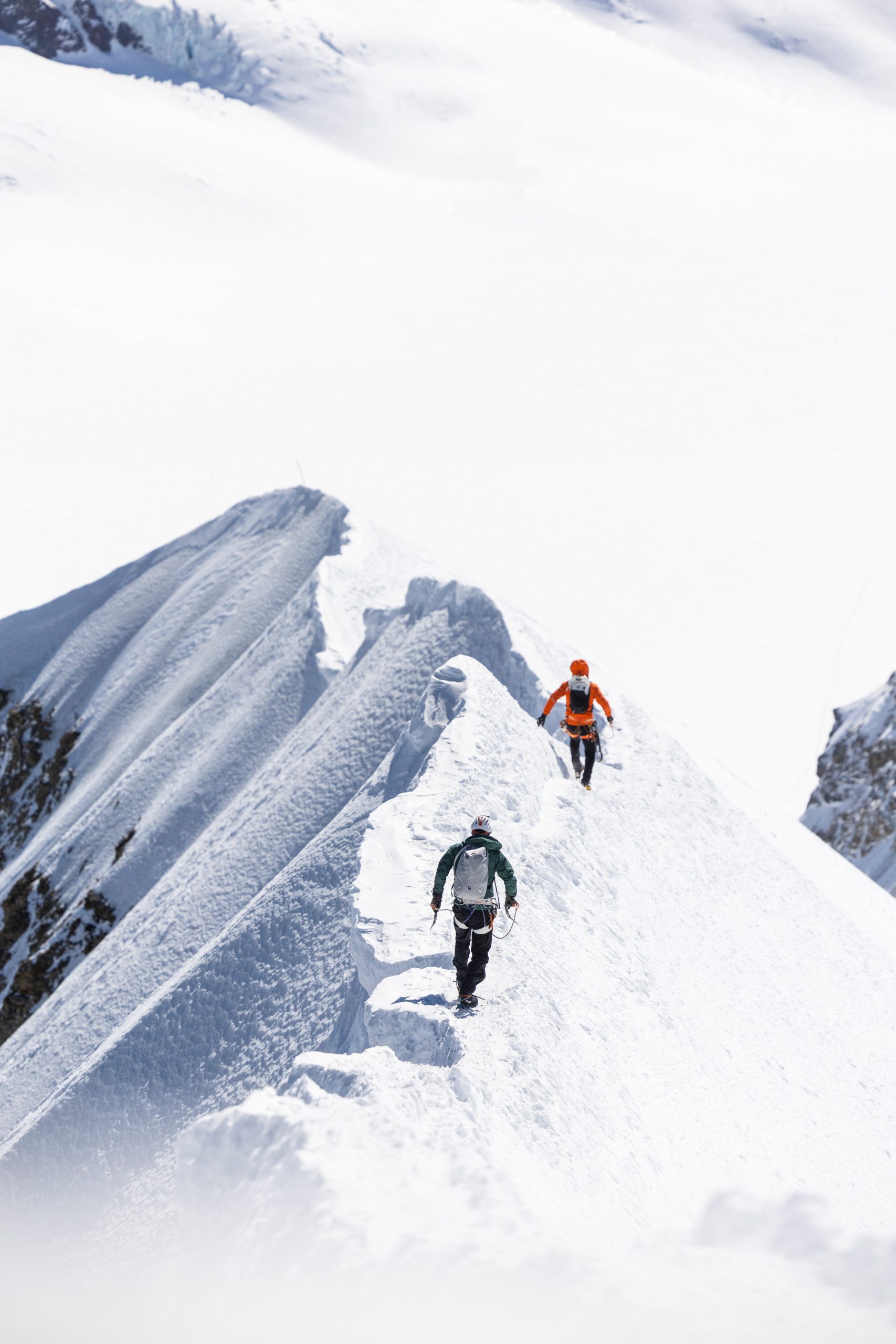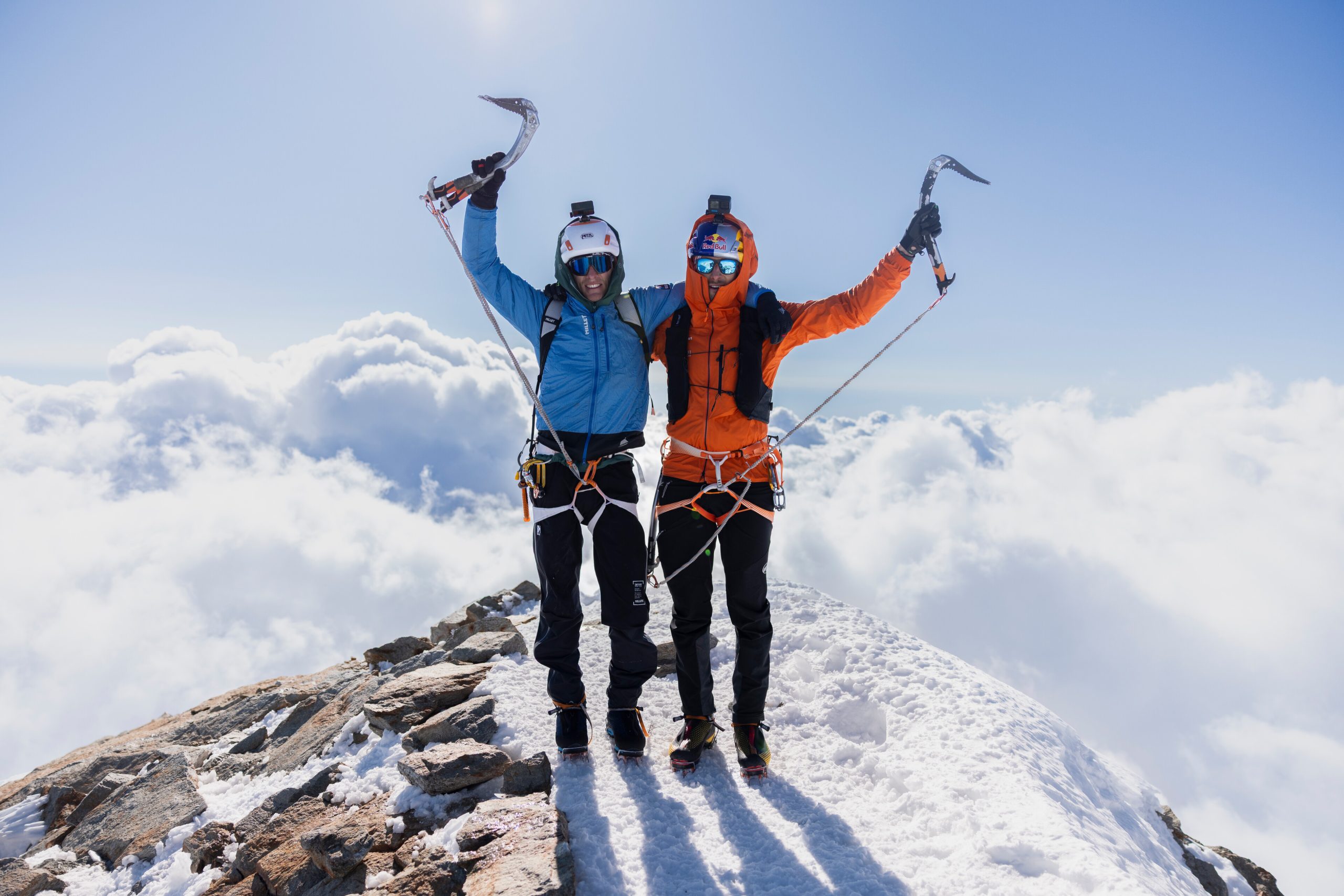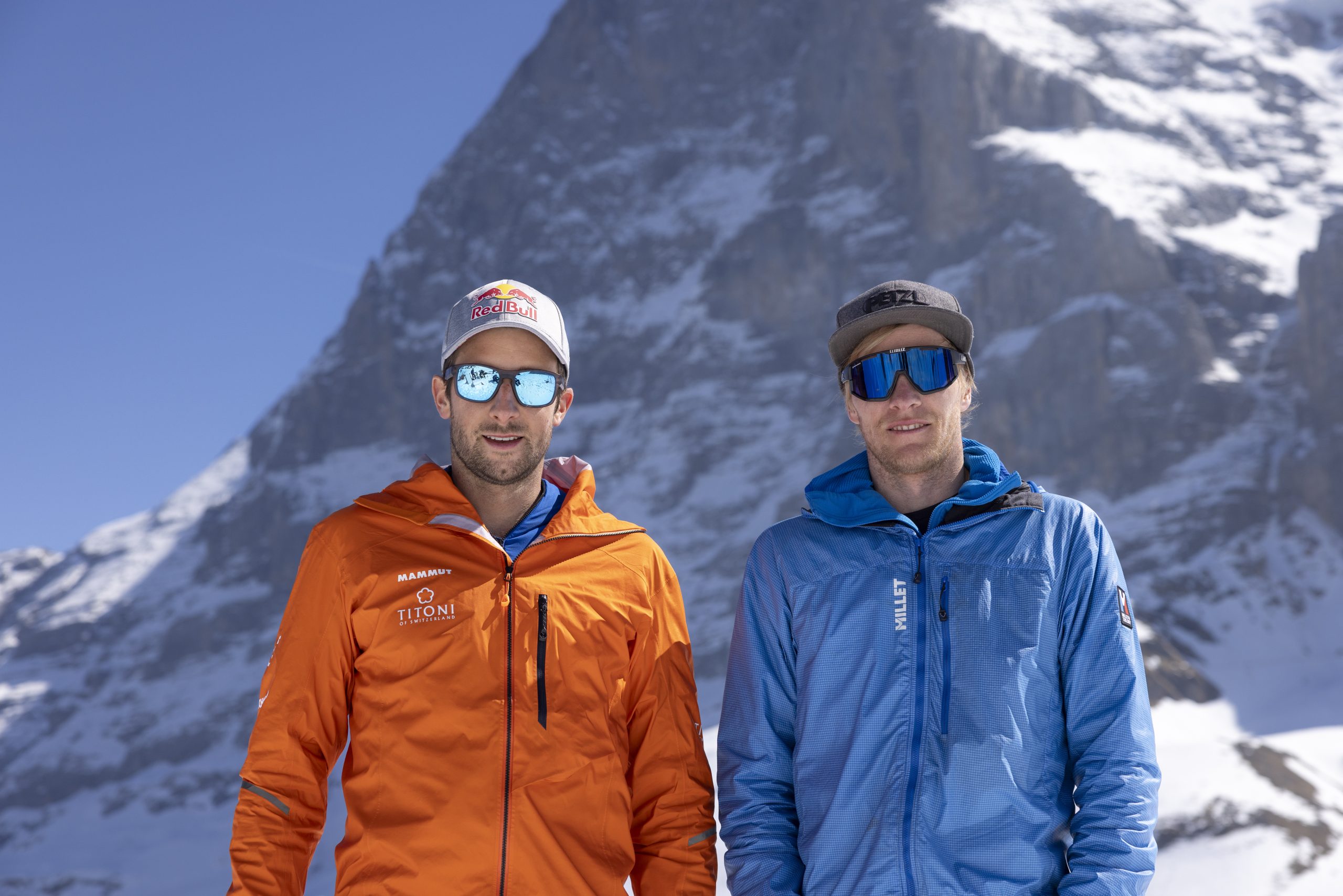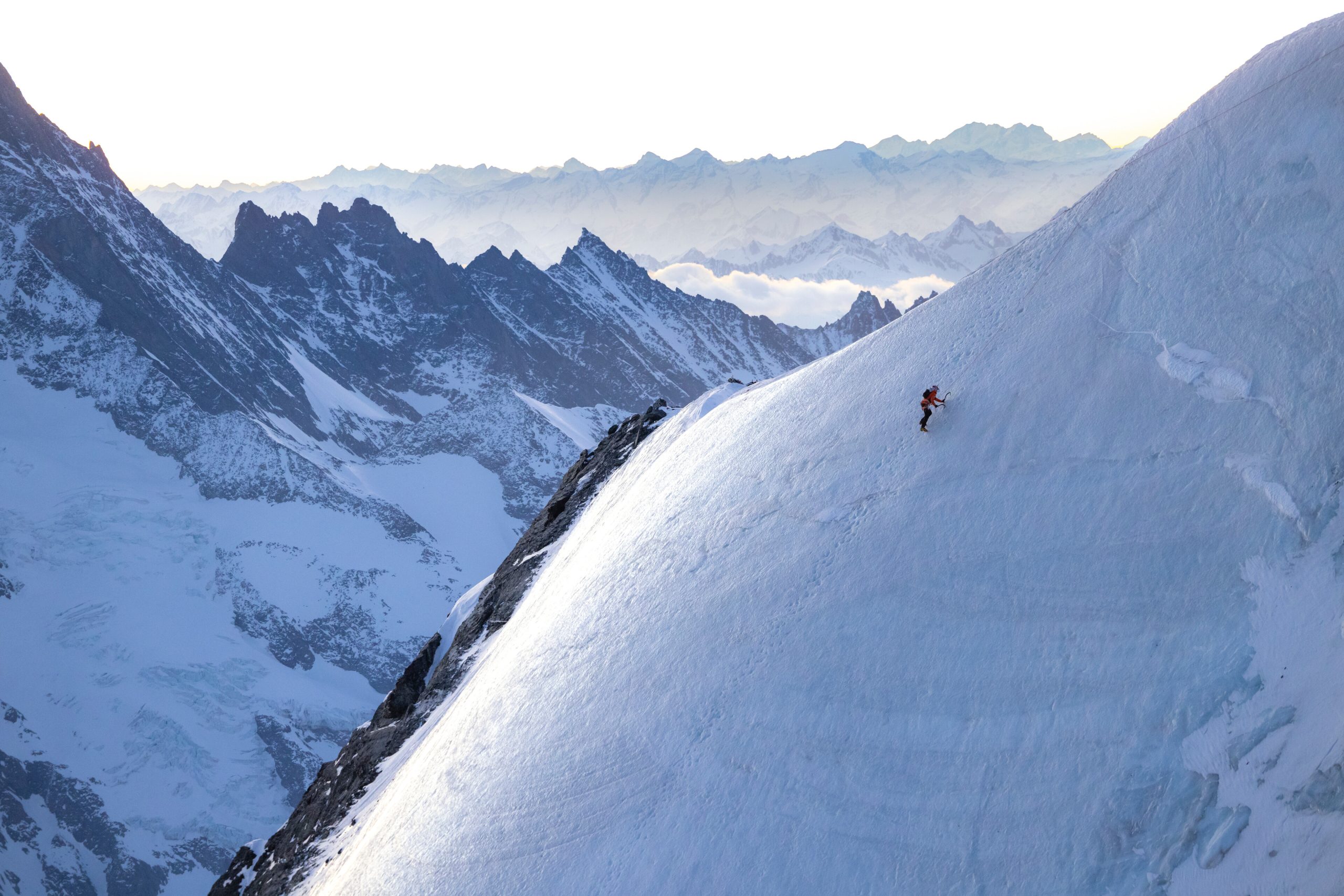

The Redbull Fastline project.
Prologue: A Line Across Three Shadows
At one o’clock in the morning on April 5, 2025, two headlamps cut across the base of the Eiger’s north face.
Above them, 1,800 meters of dark limestone and ice rose into a moonless sky.
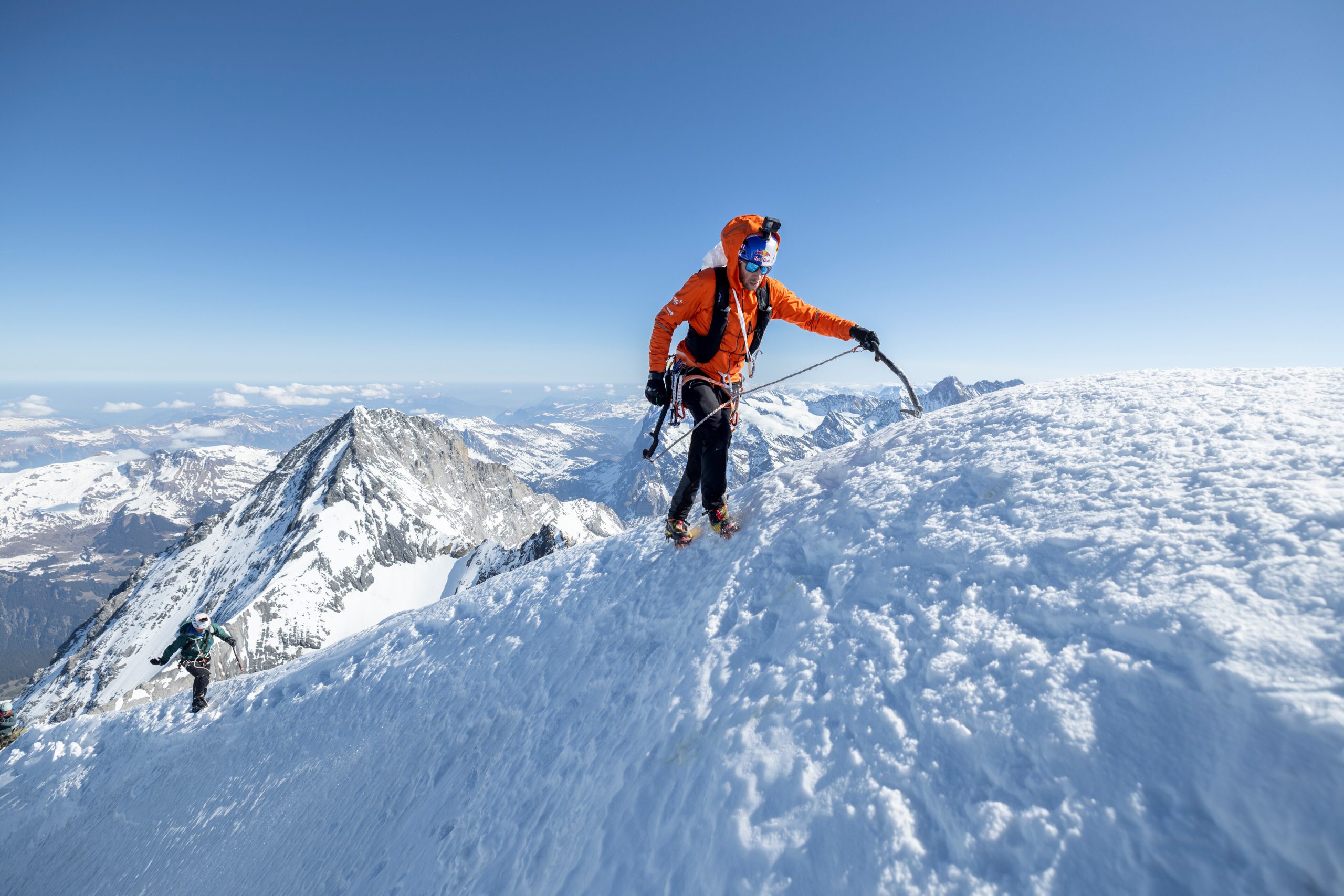
Swiss alpinist Nicolas Hojac and Austrian Philipp Brugger had one goal: climb the north faces of the Eiger, Mönch, and Jungfrau—the legendary Trilogy of the Bernese Alps—in a single push, faster than anyone before.
By the time the sun dipped again behind the western ridges, they stood atop the Jungfrau, their clocks reading 15 hours and 30 minutes.
The old record, set 21 years earlier by Ueli Steck and Stephan Siegrist, had fallen by nearly ten hours.
“We would have been happy with 19 to 21 hours. The fact that it was even less shows that we’re often capable of more than we think.”
— Nicolas Hojac, Reuters interview, April 2025
The Faces That Defined a Generation
The trilogy isn’t just a challenge of endurance; it’s a thread through modern alpine history.
The Eiger, first climbed in 1938 by Anderl Heckmair and team, remains one of the world’s most intimidating north faces. The Mönch and Jungfrau, its neighbours, are less notorious individually but no less technical. Together, their combined elevation gain approaches 4,000 vertical meters across steep rock, ice, and mixed terrain.
In 2004, Steck and Siegrist made history by completing the three north faces in 25 hours, a benchmark that seemed untouchable for two decades. Even Steck himself—a climber who redefined solo speed—suggested that breaking 20 hours would require “perfect conditions and extraordinary luck.”
Those conditions arrived in early April 2025.
Two Climbers, One Vision
Nicolas Hojac, 32, is no stranger to fast alpine ascents. Based in Interlaken, he’s previously set speed records on the Matterhorn north face and completed linkups across the Alps that merge endurance with technical precision.
Philipp Brugger, 33, from Innsbruck, Austria, comes from a background in ski mountaineering and trail running—skills that shaped his approach to pacing and altitude adaptation.
They had planned the Trilogy since 2022. But the mountains, and life, intervened.
In 2023, bad weather forced an aborted attempt. In 2024, Brugger was hospitalized with a perforated bowel, an injury that nearly ended his athletic career.
“I never would have thought that a year later I’d be standing on the Jungfrau with Nico.”
— Philipp Brugger, Reuters interview
Recovery and resilience became the quiet prelude to their record. By early 2025, both athletes were fit, synchronised, and ready for a narrow spring window when the faces might hold enough ice for security but not too much for speed.
The Climb: Three North Faces in One Day
Eiger – The Heckmair Route
They began at 01:00 from the Eigergletscher station, climbing the classic Heckmair Route under headlamps.
The line is steep, exposed, and famously complex—mixed ground of brittle limestone, neve, and hard ice.
They reached the summit in 5 hours 43 minutes, roughly one-tenth of the time most teams require for the same ascent.
Short rest. Rehydrate. Descend. Move toward the Mönch.
Mönch – Lauper Route
The Lauper Route is an elegant yet sustained climb: steep icefields leading to brittle rock bands, then a snow crest to the summit.
During this stage, they discovered a missing sling—critical for a shoulder-stand section—and improvised a solution. The margin for error was razor-thin.
They continued upward, pacing each other in silence, summiting in bright midday light.
Jungfrau – The Final Push
By early afternoon, they reached Jungfraujoch, where they took a 25-minute pause—their longest rest of the day—to melt snow, eat, and reset.
Three days earlier, they had broken a trail across part of the Rottal route, easing navigation through soft spring snow.
They topped out on the Jungfrau around 16:30 local time, exhausted, elated, and almost disbelieving.
Alpine Speed North Face Essentials
(gear pulled from verified sources — Red Bull Content Pool, Lacrux, Watson.ch)
| Item | Description | Approx. Weight |
|---|---|---|
| 15L Alpine Pack | No bivouac gear | 900g |
| Ice Tools | Technical mixed terrain | 650–700g each |
| Crampons | Petzl Irvis, step-in | 550g |
| Rope | 30m, half/6mm for emergency belay | 1.2kg |
| Helmet | Lightweight climbing | 300g |
| Gloves | Insulated technical | 150g |
| Base Layer | Synthetic top & bottom | 250g |
| Mid Layer | Synthetic insulated jacket | 400g |
| Shell | Lightweight waterproof | 300g |
| Footwear | Mountaineering boots | 1.5kg |
| Hydration/Nutrition | Soft flasks + gels | 500g |
| Misc | Harness, micro belay device, minimal slings | 400g |
| Optional Micro Stove | For Jungfraujoch stop | 300–400g |
Total pack weight: ~6.5 kg per climber
Timeline – North Face Trilogy Speed Records
| Year | Climbers | Time | Notes |
|---|---|---|---|
| 1991 | Michel Piola, Daniel Anker | ~40h | First continuous link-up attempt |
| 2004 | Ueli Steck, Stephan Siegrist | 25h 00m | Original speed record |
| 2025 | Nicolas Hojac, Philipp Brugger | 15h 30m | New record |
Why It’s More Than Just Fast
Speed records are often dismissed as spectacle. But this one signals several shifts:
Exposure time reduced – less time on dangerous terrain; darkness, rockfall, avalanches demand exposure awareness.
Mental resilience under crisis – overcoming illness, managing fear, maintaining composure through three massive north faces back-to-back.
Alpine minimalism evolving – carrying less, pacing smarter, using prior reconnaissance without compromising integrity.
Epilogue: After the Clock Stops
After descending the Jungfrau, the pair reached the valley at dusk, quietly sharing a beer with friends.
No crowds, no medals. Just the quiet satisfaction that only those who spend a day under the Alps’ great shadows can understand.
Records in the Alps don’t last forever. Weather changes. Athletes evolve.
But the Eiger–Mönch–Jungfrau Trilogy, done in 15 hours 30 minutes, has redrawn the line between possible and impossible.
Sources / Verification
Reuters, “Hojac and Brugger shatter speed record by almost 10 hours in Swiss Alps,” April 2025
Lacrux Klettermagazin, April 2025
Watson.ch, “Le record de Steck … battu,” April 2025
Alpin.de, April 2025
Red Bull Content Pool, April 2025
EverestMountain.co.uk, April 2025