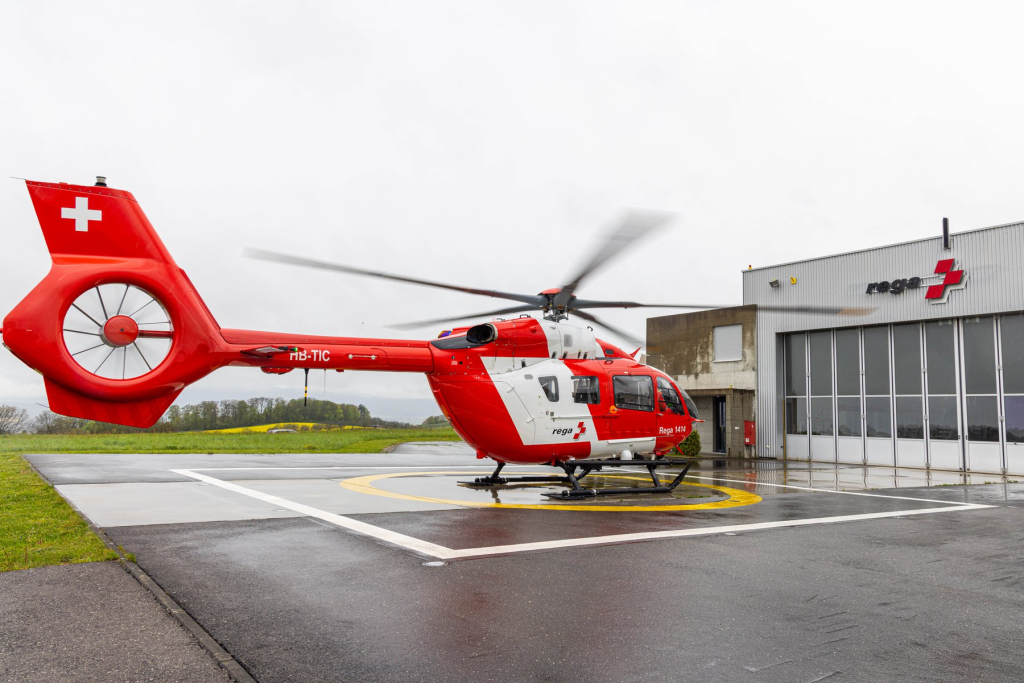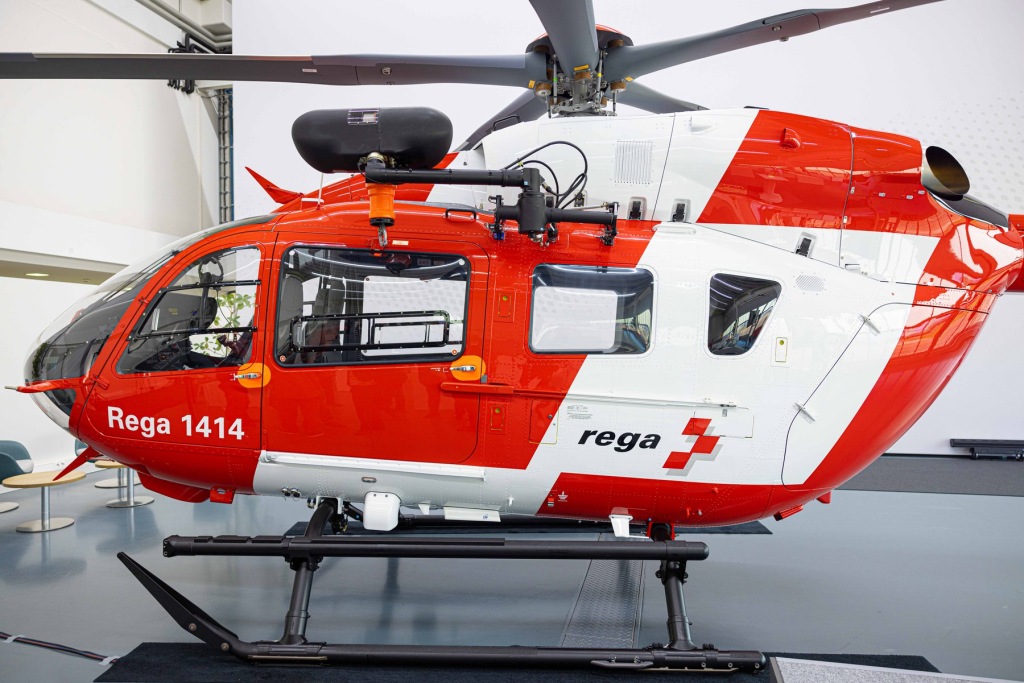

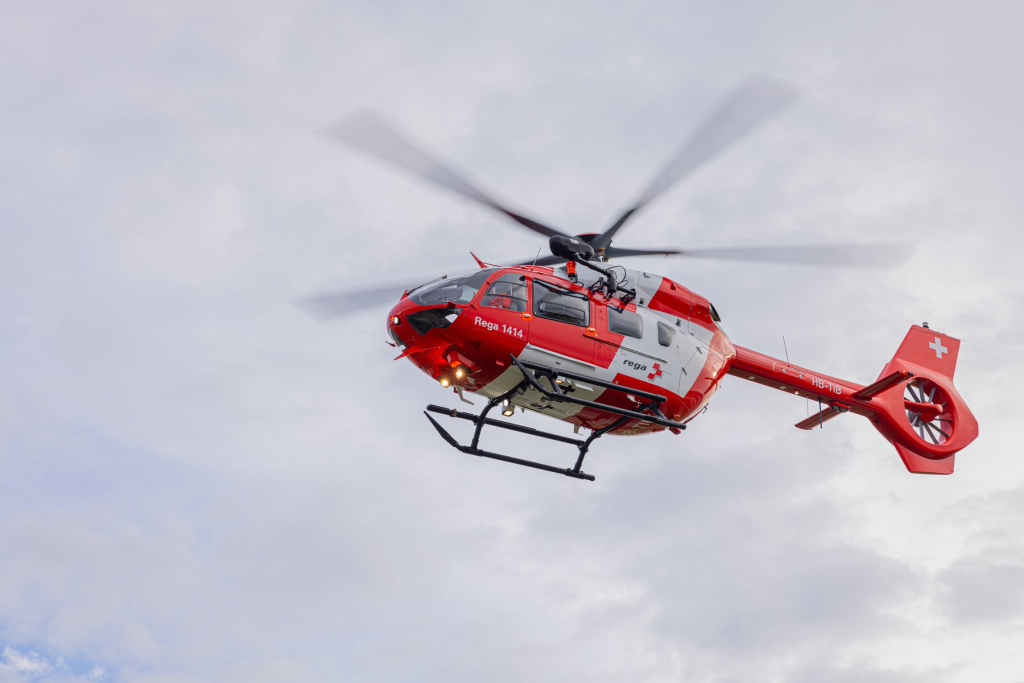
Switzerland’s iconic red rescue fleet begins a bold transformation, as Rega’s five-blade Airbus H145 D3 enters service across the Alps.
On a damp spring morning in Lausanne, the familiar red‑and‑white silhouette of a Rega helicopter lifted clear of the apron and swung into a tightening circuit above Lake Geneva. From a distance it looked like business as usual, but up close something was different: the rotor disc blurred into a perfect circle, its five blades silent and elastic in the rain‑laden air. The aircraft—internally dubbed “E45” by Rega’s engineers but formally an Airbus H145 D3 five‑blade—is the first of 21 machines that will replace every other rescue helicopter in Switzerland by 2026.
A helicopter built for Switzerland
Rega’s traditional mountain work demands power at altitude, room for a stretcher and hoist, and avionics that can coax a path through cloud‑choked valleys. The H145 D3 adds 150 kg of payload over the four‑blade version, climbs comfortably above 5,000 m and cruises at about 230 km/h—yet its bearing‑less rotor reduces vibration and maintenance. Inside, a flat‑floor cabin the size of a small ambulance fits a full intensive‑care setup; outside, a 90‑metre winch lifts 250 kg from ledges that barely count as landing zones.
Rega also asked Airbus for something bespoke: a four‑axis autopilot linked to satellite‑based RNP‑AR procedures that let crews shoot curved approaches down valley spurs in fog or snow. The Swiss regulator certified the system last year; early figures suggest it may halve the number of weather‑related stand‑downs that currently leave around 600 would‑be patients waiting each year.
From patronage to premium hardware
The price tag for 21 brand‑new helicopters and their medical interiors is north of CHF 200 million. None of it comes from taxpayers. Rega is a private, non‑profit foundation whose lifeblood is the annual contribution—still just CHF 40—from more than 3.5 million patrons, equal to two out of every five Swiss residents. That solidarity model, created in 1966 when the service nearly went broke, still covers roughly two‑thirds of operating costs; insurers pay the rest.
How the system works
- 14 helicopter bases dot the country, each on permanent 15‑minute readiness; a central operations centre at Zurich airport fields the famous 1414 emergency number and dispatches the nearest crew.
- A standard mission crew is three‑strong—pilot, emergency doctor and paramedic‑winch operator—though Alpine cable‑way rescues may add a Swiss Alpine Club specialist.
- Long‑range repatriations use three Bombardier CL‑650 Challenger jets stationed in Kloten, able to fly an intensive‑care patient home from anywhere on the globe.
Demand that never sleeps
Rega’s red tail fins were sighted 19,667 times in 2024, moving 12,847 patients—or 35 people every single day. Even that was a fraction below the record‑setting 2023 tally of 20,647 missions. Road crashes, ski injuries and cardiac events dominate the call log, but sorties range from winching climbers off icy ridges to flying premature babies between neonatal units.
The E45 in the field
- Extra lift at altitude – the D3’s Safran Arriel 2E engines and lighter rotor head give crews an additional 150 kg of payload: enough for a doctor, paramedic, ventilator, ECMO pump and fuel for a mountain round trip.
- Precision IFR in bad weather – coupled with RNP‑AR, crews can spiral down clouded valleys that were previously no‑go, buying golden minutes for stroke or trauma victims.
- Single‑type fleet – mechanics, spare‑parts logistics and simulator time all shrink when every base operates the same aircraft; Rega estimates millions saved over the next 15 years.
- Quieter rescue windows – acoustic tests show the five‑blade rotor shaves several decibels, a welcome gain for valley villages already juggling tourism and tranquility.
A brief flight through REGA history
- 1952: Dr Rudolf Bucher organises the first Swiss helicopter rescue near Davos and founds Rega.
- 1966: Facing insolvency, Rega invents the patron model—anyone can “join” for a modest annual fee.
- 1971: Patrons finance the first Alouette III outright; the crimson livery becomes a national icon.
- 1980: Crews free a sky‑diver whose parachute snagged an aircraft tail, mid‑air—a stunt now cited in aviation textbooks.
- 2009: Delivery of 11 AgustaWestland AW109SP “Da Vinci” helicopters tailored for high‑mountain bases.
- 2022‑25: Two‑tier H145 purchase (nine, then 12 airframes) paves the way for today’s E45 fleet renewal, the largest capital project in Rega’s history.
Training for tomorrow
Pilot conversion onto the H145 D3 runs in a full‑flight simulator at Opfikon, certified in 2024 for the new variant. Winch operators rehearse cliff extractions on a purpose‑built tower near the Rega Centre; doctors rotate through university hospitals to keep trauma skills sharp. The philosophy, says head of training Patrick Klaus, is “fly less on hope, more on data”: every sortie feeds back into a safety database analysed for trends.
Inside a typical rescue
- Alarm, 10:42: A climber falls on the Mittellegi Ridge of the Eiger. His partner dials 1414 via the Rega app, which transmits GPS coordinates.
- Take‑off, 10:47: Rega E45 lifts from the Bern base, 60 km away. En‑route the doctor receives photos of the injury uploaded by rescuers.
- Hover, 11:02: At 3,600 m the pilot uses the four‑axis autopilot to hold station in rotor wash; the paramedic lowers the doctor 40 m on the winch.
- Cabin, 11:08: A femoral fracture is splinted; vital signs stabilise.
- Hospital roof, 11:19: Thanks to the new RNP‑AR approach, the crew lands through scattered cloud on the Inselspital trauma pad in Bern. Total ground‑to‑hospital time: 37 minutes.
Looking ahead
The first wave of H145 D3 helicopters will finish rolling out across the lowland bases by winter 2025; mountain stations such as Samedan and Locarno follow in 2026 as the last AW109SPs retire. Rega engineers are already trialling synthetic‑vision goggles and lightweight battery‑powered rescue hoists that could appear in mid‑life upgrades. For patrons, none of this changes the bargain: a modest annual donation keeps the red helicopters flying, ready to answer a call that—last year alone—came every 26 minutes.
In a country where avalanche fences share postcards with chocolate‑box chalets, the E45 is more than a new helicopter. It is Switzerland’s latest insurance policy, a whirring promise that help can appear out of cloud and granite, hover in the thinnest air and carry the injured to safety before the hour is out. Rega calls it simply “service for the patient.” For the rest of us, it looks—and sounds—like hope on an Alpine horizon.
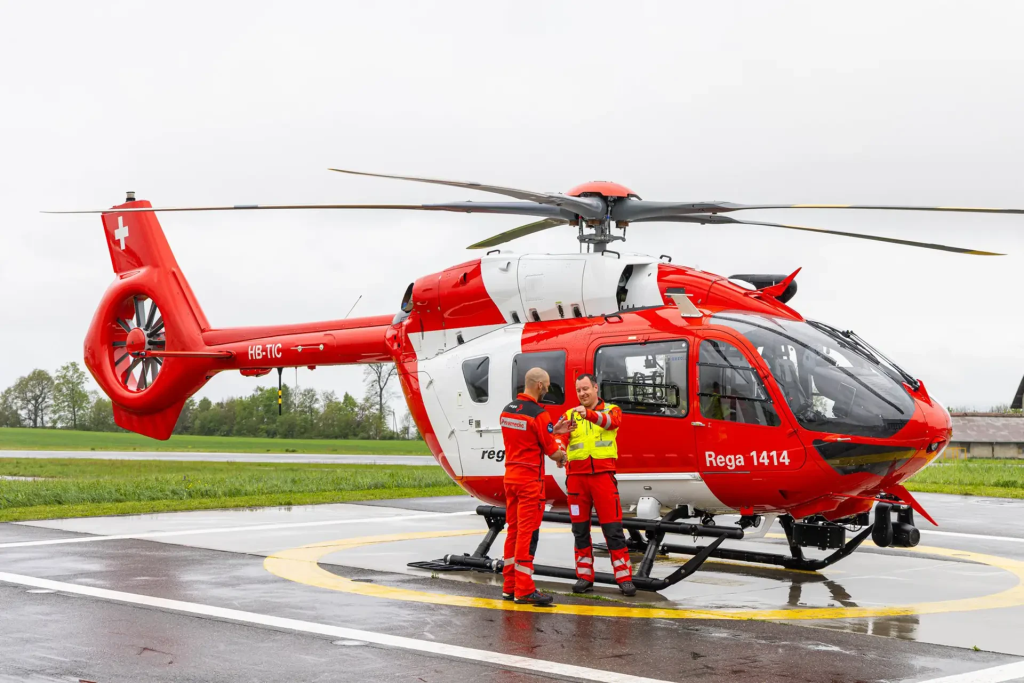
Photo: Rega
Rega received their first Airbus H145 D3 “E45” at Zurich Airport in December 2024, and outfitting with medical interiors followed through early 2025. The Lausanne base became the first to operate it in spring 2025, with initial missions flown from March onwards.
Become a Rega Patron (and Pay the Annual Fee)
- Flat-fee air rescue coverage
Patrons (over 3.5 million Swiss households) pay only a modest annual membership—still amazing value at only CHF 40. In return, Rega covers all rescue, repatriation, and intensive-care flights, even abroad*. - Access to international repatriation
Their fleet of three Bombardier Challenger CL‑650 jets provides intensive-care transfer from anywhere in the world, all included in the patronage cost*. - Never-bill promise
No hidden costs—any call-out by Rega, even in high mountains on a stormy night, is covered for patrons.* - Non-profit, privately funded
Rega remains independent from government funding. Patron contributions pay around two-thirds of operational costs, with the remainder from insurers.
*Rega can waive all or part of the mission costs provided that they are not covered by your health or other insurance policy.
APP: How the Rega App Works
- Emergency call button: Instantly dial 1414 with geolocation and altitude data sent automatically.
- GPS coordinates: Even without voice, the app reports precise position to the Rega control center.
- Mission tracking: Users can track assignment acceptance and ETA in real time.
- Member info: Displays patron status to reassure both caller and dispatcher.
- In-app medical advice: Before rescue arrives, instructions and first-aid guidance may be available.
This digital integration saves critical minutes in mountain rescues.
Rega & Air-Glaciers Cooperation in Valais
- Legal setup: Valais has delegated aerial rescue to Air-Glaciers (Romand) and Air Zermatt (Haut-Valais); Rega doesn’t hold Valais cantonal rescue contracts.
- Coordination roles: Rega stationed a Da Vinci AW109SP in Sion from 2023 under an agreement with local operator Héli‑Alpes, offering ICU transfers and base coverage.
- Dispatching: Air-Glaciers and Air Zermatt remain primary. Rega may respond only for inter-canton transports or intensive-care transfers, invoked by hospital call centers or via Rega’s national 1414 when appropriate.
- Valais system: Final mandate determined by cantonal authority; Rega’s appeals are ongoing but currently not chosen by OCVS.
Mountain Rescue and Air Ambulance: Rega’s Mission Scope
| Domain | Details |
| Mountain rescue | Core focus: rugged terrain, alpine ridges, glacier missions with winch-equipped helicopters . |
| General medical evacuation | Transfers from hospitals to ICUs, including premature babies and ECMO patients . |
| Global repatriation | Three CL-650 jets at Zurich for long-distance patient transport . |
| Livestock & environmental support | Occasional missions aiding alpine farmers (livestock rescue, carcass removal) . |
Summary
- First E45 delivered: December 2024 (Zurich), operational in Lausanne spring 2025.
- Patrons receive comprehensive rescue & repatriation coverage for a small fee.
- App enhances speed and accuracy of mountain rescues.
- In Valais, Air-Glaciers and Air Zermatt remain lead rescue providers, with Rega supporting non-mountain ICU transfers.
- Rega spans from remote alpine missions to international aeromedical flights—always no-cost to patrons.
Photos: Rega
Become a patron: https://portal.rega.ch/en/login