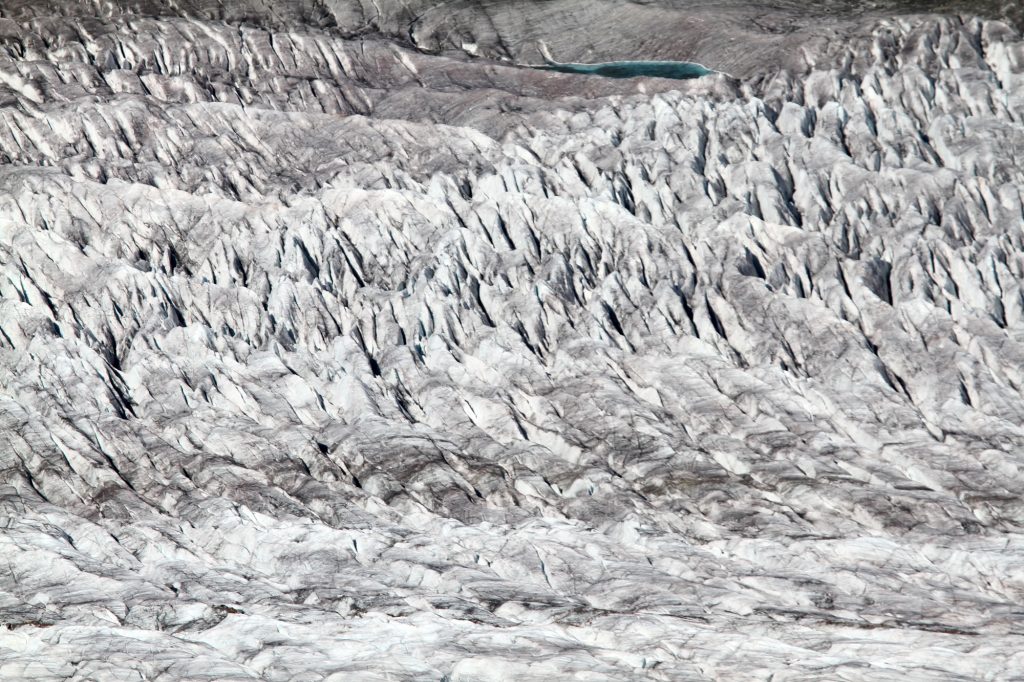

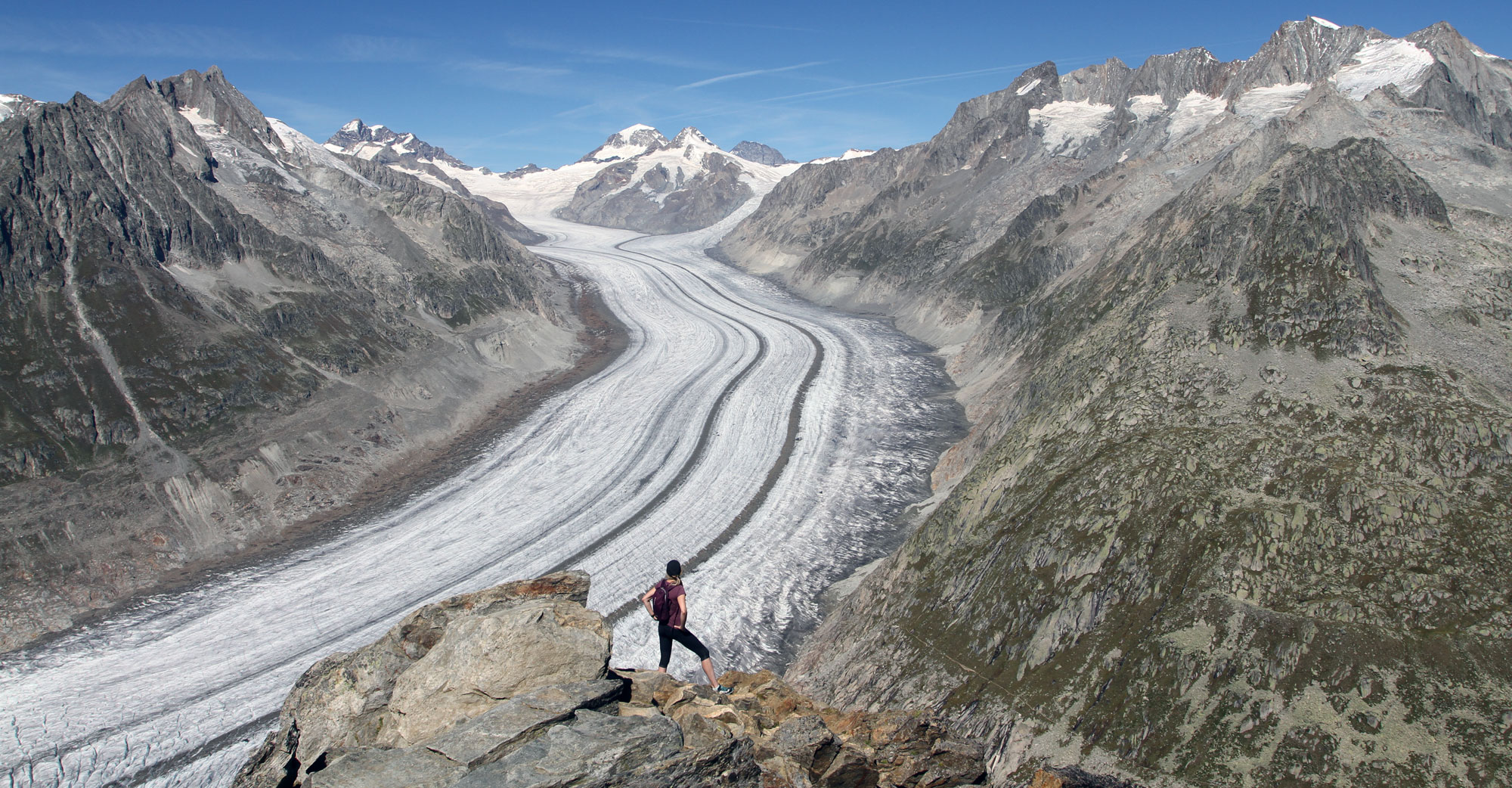
Not to sound nostalgic, but standing on the Eggishorn ridge above the Aletsch Glacier, it’s impossible not to feel it: a landscape in retreat, a witness to climate unraveling. For decades, this glacier—the largest in the Alps—has lured hikers, ski tourers, paragliders, and trail runners into its immensity. But today, it’s shrinking faster than ever. Despite the countless features, documentaries, and Instagram reels about the Aletsch’s retreat, the pace and consequence of that retreat keep deepening. And for those who move through the high mountains under their own power, it’s becoming a very different playground.
From the air, the Aletsch still appears monumental—a frozen white tongue stretching 22 kilometers down from the Jungfrau. But on foot or skis, it reveals its wounds. Moraines mark where the ice once stood only decades ago. Meltwater rivulets crisscross newly exposed scree. In summer 2025, the glacier thinned by nearly 3 meters, part of a pattern repeating across the Alps.
For trail runners and ski mountaineers, this means more than aesthetics. Classic glacier approaches like the Konkordiaplatz loop or the Märjelensee circuits are now laced with newly revealed boulder fields and fragile permafrost slopes. The once-predictable spring ski descents from the Jungfraujoch demand earlier starts and different route-finding, as crevasses open wider and snow bridges collapse weeks ahead of the usual melt schedule.
Running Along Absence
Some of the most stunning trails in the Alps hug the flanks of the shrinking Aletsch—like the route from Bettmerhorn to Märjelensee, now running beside a trench where glacier once met alpine lake. Trail races such as the Aletsch Half-Marathon still draw thousands, but the glacier that once framed every photo has receded so far that in places, runners no longer glimpse it at all.
Outdoor sports athletes are adapting—but also advocating. In September 2024, a group of Swiss mountain runners held a symbolic start line where the glacier reached in 1990. The finish was 2.1 kilometers down-valley, marking its 2024 terminus. It wasn’t a race, but a vigil.
Paragliding into the Thermals of Change
Thermal shifts above the glacier are also changing. Paragliders who once soared along stable uplift lines now report more turbulence, particularly in late summer. The loss of ice means more exposed rock and earlier heating—creating inconsistent airflows. Some launches near Riederalp and Belalp have seen declining flight days or required shifts in timing.
“I don’t just need wind now—I need the right sun angle on moraine slopes,” said one pilot from the Oberwallis region. “Flying here has become like playing chess with the climate.”
The Forgotten Glacier: Rhone’s Vanishing Act
Further west, atop the Furka Pass, the Rhone Glacier offers a sobering counterpart. In the 1980s, its front tumbled dramatically down a cliff just below the pass road—visible from hotel balconies and postcards. Today, it has retreated so far into its own cirque that tourists at the historic Hotel Belvédère need to hike to see it.
An increasingly desperate attempt to preserve the tourist attraction has led to the construction of a tent-covered ice grotto—a tunnel carved into the glacier and shaded under white fleece to slow the melt. The effort is poetic and pathetic all at once: a small gesture against a vast, irreversible trend.
For ski tourers who used to drop in from the Rhonegletscher to the Galenstock, the routes have become rocky and exposed. Ice transitions have lengthened. Some guides now advise clients that the classic descent is no longer “advisable in midsummer.”
The Shrinking Frontier
The Alps have always been shaped by glacial motion. What’s new is the pace—and the implications for those who rely on stable terrain. Mountain huts once built beside ice now perch awkwardly above receding cliffs. Access ladders grow longer every season. The Finsteraarhornhütte, once an easy skin from the Aletsch, now requires navigating new moraines and unstable gravel ramps.
And yet the human pull to these places remains fierce. Ultra runners still circle the Oberaletsch, climbers still ascend the Gross Grünhorn, and paraglider pilots still launch above the Konkordiaplatz. Perhaps because, like the glaciers themselves, alpine sports culture endures through adversity.
From Witnessing to Acting
Athletes and adventurers are increasingly using their platforms to advocate. Trail races are now carbon-offsetting logistics. Paraglider associations fund glacier monitoring stations. A small ski-touring brand from Valais recently committed 2% of profits to high-mountain research. Even tourism boards, long wary of climate messaging, now offer educational hikes showing glacier loss across time.
The message is shifting from lament to response. Not just mourning the ice, but learning to move differently in a thawing world. This summer, as the freezing level pushed beyond 5,000 meters across the Alps for the first time on record, even seasoned guides paused. A zero-degree line above the Mont Blanc summit is not just rare—it’s surreal.
Personal Memory as Documentation
Those with decades of mountain days behind them carry a kind of oral archive. The first time I saw the Rhone Glacier, it was audible before visible—creaking and cracking beside the Furka road. Today, the silence is deafening. Photos taken from the same spot now show bare rock and a gravel-strewn basin. It’s a kind of mourning, but also a call to witness.
If you’ve paraglided from the Bettmerhorn, run the ridge to Eggishorn, or skied the Aletsch firn on a spring morning, you know the pull of this landscape. That pull now comes with responsibility: to speak, to act, to adapt.
Resources
Have your own photos or stories? Submit them to us, and help build a community archive of personal glacier memory.