
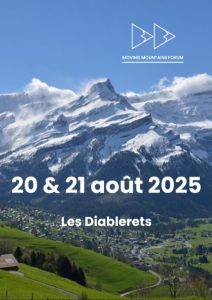
Les Diablerets, Vaud. Not many sustainability conferences are founded by someone who happily calls himself “the world’s most cynical environmentalist.” When British clean‑energy investor and former Olympic skier Michael Liebreich launched what is now the Moving Mountains Forum in 2012, the charge he gave the village‑sized gathering was blunt: “No glossy manifestos. Show me things that work.” Thirteen editions later, the event—and, more importantly, the projects it has seeded—have reached the point where they can begin to answer Liebreich’s perennial challenge.
Liebreich is no stranger to the collision of idealism and execution. Before founding the forum, he launched the global energy data company New Energy Finance, which was later acquired by Bloomberg. He also built the early online skiing community IfYouSki, and represented Great Britain in alpine skiing at the 1992 Albertville Winter Olympics, writing a books with his sister on skiing. His connection to the alps has been a lifelong passion. Today, his reputation blends blue-chip finance with a streak of rigorous pragmatism—a rare combination that gives Moving Mountains its unusual clarity of purpose.
Today the forum remains small and deliberately focused. The most recent edition, held in August 2024, drew around 160 delegates—local officials, researchers and outdoor‑industry entrepreneurs—to debate the theme “Tomorrow’s Climate Exodus.” Sessions ranged from low‑snow business models to micro‑grid finance. The most‑quoted takeaway was sober: “Ideas are no longer the bottleneck; implementation is.”
That sentiment shaped the forum’s first Call for Sustainable‑Transition Projects, co‑funded by Canton Vaud. The programme offers CHF 30,000 seed grants, covering up to two‑thirds of costs, for village‑scale trials in energy, mobility and circular economy. Applications closed at the end of October 2024; short‑listed teams were announced at Christmas, and contracts are being finalised this summer.
If Liebreich’s litmus test is tangible change notable from a chair‑lift, DiabLab is the current benchmark. Born from a 2019 forum workshop, DiabLab is turning the entire village’s public lighting into an open‑source live experiment. LED luminaires equipped with Schréder EXEDRA controls retrofit to existing poles, monitored by real‑time dashboards logging energy use, light pollution, insect activity and resident feedback. The pilot street cut electricity consumption by 62% versus 2022 levels. A full rollout is financed for autumn 2025. Every document—from tender specs to sensor code—is published under a Creative Commons licence. Three other communes (Bussigny, Troistorrents and Busswil) have already requested replication kits.
Among other early-stage pilots are a free summer e-minibus linking Diablerets to Lac Retaud, an upcycling initiative converting retired ski boots into furniture, and a trail-restoration crew testing low-cement geopolymer to curb erosion on popular routes.
The organisation is structured as a Swiss non-profit headquartered in Aigle. Its board is chaired by journalist Thierry Meyer, with Liebreich leading the Advisory Board. Annual funding is around CHF 220,000—half from sponsors such as Romande Énergie, Salt Mobile and Glacier 3000, and half from ticket sales. Financial records are public and reviewed annually, a transparency move Liebreich insisted upon after just two years.
Do these efforts make a dent? By the end of 2025, Moving Mountains has four concrete pilot projects underway, up from zero two years earlier. Delegation numbers are up 45%, and several pilot schemes are being replicated beyond the Vaud region. DiabLab alone has sparked five toolkit enquiries, and early data shows a 62% drop in street-lighting energy use on the Route des Ormonts. It’s modest but material progress—the kind of quiet, replicable success Liebreich argues is the only meaningful metric.
Critics might still ask whether Moving Mountains is just another talking shop. It isn’t. One of the forum’s two days is now solely devoted to follow-ups on previous pledges, and the call-for-projects framework ensures that ideas are anchored by funding. Each pilot must show a path to revenue neutrality within three seasons; for example, the Diablobus will shift to the existing Mobilis fare network if ridership hits 40,000 passenger-kilometres.
The forum’s influence is also growing outside French-speaking Switzerland. Case studies have begun appearing in the Regiosuisse alpine knowledge-hub, and the forum’s open-source approach means other cantons can adopt and adapt ideas freely.
The 14th edition, scheduled for August 2025, will focus on regenerative mountain agriculture—covering soil health, nitrate run-off and agri-solar. It will connect Alpine farmers with EPFL agritech labs and high-end F&B buyers. Drafts suggest field visits to methane-reduced dairy farms and a biodiverse vineyard in Aigle. A second Call for Projects will extend eligibility beyond Vaud, with a planned funding pool of CHF 600,000, thanks to new sponsorship from Swiss Life Asset Managers.
By conventional startup metrics, Moving Mountains is tiny. Yet its credibility lies precisely in that bricolage scale: discrete pilots visible from a village street, a governance model built on radical transparency, and an insistence on publishing both successes and flops. For a movement born in a school gym, that is substantive progress—not an eco‑festival, but a modest accelerator for places that tourism and climate volatility often leave behind.
Whether that is enough to satisfy Michael Liebreich’s seasoned cynicism remains to be seen. What is clear, however, is that the forum he founded has crossed the line from ideas to evidence. And in 2025, evidence is the only currency that counts.